What is Effective Questioning?

Effective questioning is a researched-effective approach to mathematics teaching that directly impacts student interest and willingness to pursue tasks. In this study, we found that examining, planning and executing effective questions has immediate impact on the level of student engagement and achievement. Teacher participants were the creators of the questions they used, rather than using externally-created questions; the strategies became their own and were integrated into regular and on-going teaching.

Through the Ministry of Education Math GAINS initiative, the Halton District School Board had the opportunity to guide a critical mass of teachers of mathematics through job-embedded professional learning experiences that shifted their questioning behaviours in ways that quickly led to improved student achievement and closed gaps.

This Digital research paper reports on a conceptual model for effective questioning in the mathematics classroom that was tested for effectiveness.

The research question asked in this work was:

Does the approach to questioning used by teachers in the classroom promote student understanding of mathematics - resulting in increased student achievement?

The learning was embedded in the classroom and the professional work of the teachers deepened their content knowledge and expertise as they learned to use more precise, personalized, and powerful questions to:

  • focus on important mathematics
  • provide access to learning for students across a broad range of readiness levels, and
  • maintaining a high cognitive level for all students, mathematically strong or struggling.

Through collaborative work including co-planning, co-teaching and debriefing , teachers developed their own emerging knowledge of questioning, enhancing their questioning practice.

The research results clearly showed that students of teachers who were involved in improving their use of questioning in the topics algebra or number sense made significant gains from the pre to the post assessment – a finding that was not observed in the comparison group. It is also interesting to note that students of the questioning teachers showed significant improvements in both strands although only focused on one strand during the questioning intervention. The increases in student achievement demonstrated the ease of transferability of teacher practice to other areas of the mathematics curriculum.

Teachers in the project used questions both to describe or set tasks as well as to scaffold and consolidate the learning. A single open question or a pair of parallel questions were often used to define the major task for students to pursue. But questions were also used to foster student discussion of their thinking on the questions and to determine to what extent and in what way the big ideas that led the teacher to set the task were understood by the students.

All headings of diagram are clickable below, to find the related research story, video and transcript.

Lin, A., Small, M., McPherson, R., Ingalls, M., Bruce, C. Flynn, T. (2010) Effective Questioning Digital Paper. Accessible at www.tmerc.ca/digitalpapers

What is Lesson Study?

Lesson Study is an intensive professional development model in which teachers learn through a process of planning and observing lessons together. Originating in Japan, lesson study involves systematic inquiry into teaching practice. Stigler and Hiebert (1999) describe lesson study as a way for teachers to look at their own practice “with new eyes”.

Lesson study has proved to be a powerful experience for teacher, because it “is embedded in the classroom and focused on students, it is collaborative and ongoing, and it is based on teachers’ own concerns and questions” (Darling-Hammond & McLaughlin, 1995). In this way, lesson study is a teacher-led or teacher-initiated activity that has the potential to increase research-based knowledge that is critical to improving instruction (Lewis et al., 2006a). Teachers “engage in lesson study as researchers and scholars of their own classrooms. Their inquiries honour the fascinating and complex nature of teaching” (Stepanek, 2001).

Like other forms of collaborative research, lesson study is a straightforward idea, but a complex process, requiring the commitment of teacher participants over a sustained period of time and an openness to learn about subject matter and its teaching and learning (Lewis et al., 2006b).

Four critical components of lesson study have been identified: goal setting, planning, implementation and debriefing. These components are derived from the lesson study cycle outlined in a seminal article by Lewis, Perry and Murata (2006).

Teacher participants begin by setting a goal for their students that they are aiming to address in their lesson. This is often something that is difficult for the students to learn, or difficult for the teachers to teach. In other words, “the desire to improve is stimulated by seeing what’s not working” (Lewis et al., 2006b). Goal setting leads to an exploration for the best instructional strategies that could be used to achieve the goal (Fernandez, 2002). During this planning stage, the teacher participants need access to outside sources of knowledge – both print (e.g., textbooks, innovative materials, outside research articles) and human (e.g., outside educators, content specialists, researchers). The lesson is taught by one of the team members while others observe, and a detailed debriefing session and reflection takes place. This debriefing period drives the continuation of the cycle as the next set of goals is established. These final phases of the cycle – implementation / reflection / debrief – should feel less like a final performance and more like a catalyst for further study and improvement of practice (Lewis et al., 2006b).

Our research has allowed us to observe teachers engaging in additional complex stages beyond these four steps. Researchers asked teachers to list the tasks that took place during the lesson study cycle with specific attention to how their time was spent. The diagram reflects our understanding of lesson study based on the research – the teacher activity that takes place during and between the formal phases of the cycle. The informal or "backstage activities" that occur between the formal phases are a significant addition to our understanding of what takes place for teacher-participants as they move through the cycle. As researchers, we recognize these in-between activities as essential building blocks of a successful lesson study cycle and as representing the real work and commitment of teachers as they support one another through lesson study.

All headings of diagram are clickable below, to find the related research story, video and transcript.
Bruce, C., Ladky, M., Flynn, T., McPherson, R. (2009) Lesson Study Digital Paper.
Accessible at www.tmerc.ca/digitalpapers

Research Story

There are four key steps to lesson study: goal setting, planning, implementation, debriefing (Lewis, Perry, Murata, 2006). In addition to these key steps, our research has allowed us to observe teachers engaging in additional complex stages beyond the key four. Researchers asked teachers to list the tasks that took place during the lesson study cycle with specific attention to how their time was spent. The diagram in this window represents what specifically took place during and between the formal phases of the cycle. The informal or “backstage activities” that occur between the formal phases are a significant addition to our understanding of what takes place for teacher-participants as they move through the cycle. As researchers, we recognized these in-between activities as essential building blocks of a successful lesson study cycle and as representing the real work and commitment of the teacher teams as they supported one another.

In the initial goal-setting phase, teacher participants begin by setting a goal for their students that they are aiming to address in the research lesson. This is often something that is difficult for the students to learn, or difficult for the teachers to teach (or both). Teachers work collaboratively to set goals, asking one another questions to hone in on the lesson goals. Further, teachers discuss the challenges they face in supporting deep student understanding of key mathematical ideas (such as proportional reasoning and understanding linear systems). At times, the learning goal is based on a testing of theories presented by other researchers and/or teachers – including seeing what students are capable of, given positive learning conditions. Often, “the desire to improve is stimulated by seeing what’s not working” (Lewis et al., 2006). Goal setting leads to an exploration for the best instructional strategies that could be used to achieve the goal (Fernandez, 2002).

The following clip is taken from the initial meeting of a group of lesson study teachers, administrators and researchers engaged in a two-year lesson study project (in four school teams). After reflecting upon the previous year of lesson study and renewing the goals of the 2008-2009 academic year as whole group, individual schools broke off into their respective teams to brainstorm what their lesson study goal might look like. One member of the team summarizes the key issue that teachers identified during their initial discussions.


To navigate: Click on parts of the diagram below to find the related research story, video and transcript.

Bruce, C., Ladky, M., Flynn, T., McPherson, R. (2009) Lesson Study Digital Paper.
Accessible at www.tmerc.ca/digitalpapers
Whole Research Story Download Diagram

Video

Transcript

Principal: Vice-principal: I think what I’m hearing you say, is that we really need to focus on the concept of volume is, area (of base) times height, right? And that seems really simple, but clearly it's not. So that could be our overall sort of theme. What does that look like in Grade 9?
Download Transcripts

What is Collaborative Action Research?

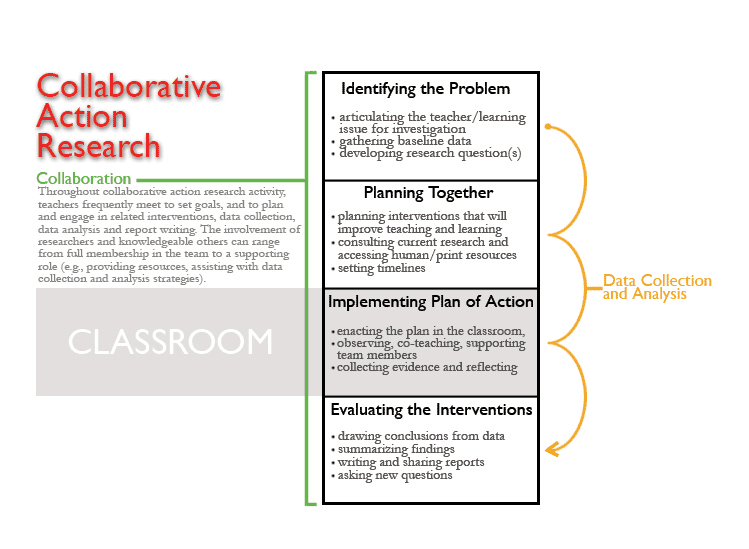
The process of action research allows educators to:

  1. reflect on an issue or a problem relevant to their teaching;
  2. to determine what research question(s) they are trying to answer;
  3. to implement an intervention designed to address the problem;
  4. to collect and analyse data to determine if their intervention is having an effect, and;
  5. to implement changes in their practice based on their findings.

One of the distinctive features of action research in comparison to other forms of research is that teacher-researchers aim to do more than simply describe or explain a phenomenon; they aim to improve their practice and student learning (Sagor, 1992). Action research has been shown to be an effective form of teacher professional development that enables teachers to closely examine issues of student learning and teaching practice (Bevevino, M.M. & Snodgrass, D.M., 2000; Hubbard & Power, 1999; Newman, 2000).

Collaborative action research refers not only to teachers working together, but to teachers and researchers working together to conduct classroom research. Ross, Rolheiser and Hogaboam-Gray (1999) defined collaborative action research as “a systematic inquiry into teacher practice that is conducted by a team of teachers and university researchers working as equal partners” (256).

In 2007, Capobianco described the following as the key characteristics of collaborative action research:

  1. Research problems are mutually defined by the teachers and the researcher;
  2. The teachers and researcher collaborate in investigating solutions to classroom-based problems;
  3. Teachers develop research competencies associated with data collection, analysis, and interpretation, and the researcher (re)educates herself or himself in research methodologies that are most appropriate to the context;
  4. The researcher and teachers share and shape their ongoing, personal, and critical reflections as an integral part of the research process;
  5. Results from the collaborative action research contribute to the collective knowledge of teaching and learning and are shared with others with an eye to improving education practices (6).

Research Background

For three consecutive years, from 2007 to 2010, the Elementary Teachers’ Federation of Ontario invested in the professional development of its members through a collaborative action research initiative – called Teachers Learning Together – where university researchers were partnered with self-identified teacher teams across the province. Researchers at the University of Windsor, Brock University, Lakehead University, Nipissing Univeristy, the University of Toronto and Trent University were engaged to work with 8-9 teacher teams each; these teams had submitted research proposals on specific topics that they were interested in investigating through the Teachers Learning Together project. The Trent University research team (comprised of Dr. Catherine Bruce and Janice Mackenzie in 2007/2008, and Dr. Catherine Bruce and Tara Flynn from 2008 to 2011 and Rich McPherson 2009 to 2011, along with quantitative researcher Dr. John Ross of the University of Toronto) supported and conducted research with a total of 26 teacher teams representing 117 teachers. This digital research paper is based on the work of the Trent teams. In the last two years of the project, teams submitted proposals focused specifically on areas of math instruction that they wanted to research in their classrooms. This multi-year, large-scale collaborative action research project is unique in the history of action research in Ontario, and indeed Canada. This study documents classroom-based action research through collaboration between: a) The Elementary Teachers’ Federation of Ontario (ETFO); b) district school boards in Ontario; and c) researchers at Trent University.

In our intensive work with teacher teams over several years, we have found the process of collaborative action research to lead to powerful learning – for us (the researchers), for teachers, and ultimately, for students.

All headings of diagram are clickable below, to find the related research story, video and transcript.

Bruce, C., Flynn, T., McPherson, R. (2011) Collaborative Action Research Digital Paper.
Accessible at www.tmerc.ca/digitalpapers
Download Research Story
Digital paper sponsored by The Elementary Teachers' Federation of Ontario (ETFO).


What is a Digital Paper?

Video documentation has become an integral component of data collection in educational research. Video episodes are viewed, clipped, analyzed, transcribed and analyzed again. And yet when it comes to writing up findings, researchers are typically forced to describe the visual nature of their data; the reader does not have access to the data and is unable to see the video itself, resulting in a “flattening” out on the experience of what was a lively, dynamic, and engaging process. Digital video is now emerging as a powerful engagement and portrayal tool; one that is helping teachers to connect with and improve their understandings and interpretation of their practice (Carraher et al., 2000; Pea, 2003).

In 2004, Olivero et al. developed a format called videopapers. A videopaper is a marriage of the traditional paper written by researchers and academics (but not exclusively so) and videotaped classroom footage of teachers and students working in real classroom situations. Combining the video with the text creates a fluid document that is more explicit than the text or video alone.

Building on Olivero’s videopaper work, in an attempt to bring video-based research to life, we have generated a conceptual and virtual framework called Digital Papers. Digital papers is a web-based tool, that allows researchers to show their findings alongside video clips, transcripts of the video clips, and conceptual models that frame their work. It is the conceptual model that drives the digital papers and distinguishes them. The diagrams are interactive and frame the ideas of the digital papers so that viewers control their experience through the diagram, navigating through a complex series of layered screens with ease. A second distinguishing feature is that our digital papers focus on one key concept (e.g., Engaging Students in Math Talk) or research story (e.g., Lesson Study as a PD Process).

Digital papers were developed by Dr. Catherine D. Bruce, an Associate Professor at Trent University’s School of Education and Professional Learning, along with teacher-researchers Tara Flynn and Rich McPherson, also associated with Trent University and the Trent Math Education Research Collaborative (TMERC). The research team is collaborating with a development team at the Ontario Ministry of Education to increase capacity and production.

How to navigate a Digital Paper:

There are four main quadrants on each screen within the digital paper:

  1. A video clip (which could be in the form of an animation or video footage in educational settings;
  2. A transcript of the video clip;
  3. A research story (which may also include question prompts for viewers and salient quotes); and,
  4. A framing diagram.


What is Demonstration Classroom?

Demonstration classrooms constitute a professional learning strategy in which teachers visit a model implementation site to learn how to implement innovative instructional practice. Demonstration classrooms may be particularly effective when teachers have difficulty imagining what an innovation would like in practice. Although models may differ and include a range of features, at its most basic, a demonstration classroom visit involves:

  1. A pre-conference, during which participating teachers meet with the host teacher to discuss learning goals, issues around planning and assessment, anticipated student responses, and other issues of interest to the host or visiting teachers. At this time, visitors may discuss and take on observation roles for the classroom visit, depending on the learning objectives of the lesson and of the teachers themselves;
  2. Teachers then attend the demonstration lesson, taking careful notes on student responses and interactions, teacher decision-making, features of the classroom or of the lesson. Observation guides, tailored to the goals of the demonstration classroom, may be used;
  3. Visitors meet with the host for a post-lesson debrief, during which observations are shared and implications discussed;
  4. Participating teachers set goals for implementation in their own classroom. Immediately following the demonstration classroom visit, teachers may be afforded release time in which to pursue these goals through further research, co-planning, etc.

This model could also be further expanded in between the activities outlined in this diagram to include support in the form of PD workshops before, during and/or after the demonstration classroom activity, visits to one another’s classrooms, observations and feedback from researchers and/or PD staff, and additional release time for co-planning/co-teaching.

As the diagram illustrates, demonstration classroom PD can be enacted as a linear model, taking teachers through the pre-visit, the classroom visit, the post-visit and finally providing some structure for setting goals in the classroom based on observations and discussions involving the demonstration classroom. The demonstration classroom experience can end here, but the literature and this research shows how a very robust model would make these activities cyclical in nature and potentially more powerful. Ideally, goal setting (the final activity in the diagram) would be a launching point to a new cycle of activity. Teachers would use this opportunity to set goals for their own classroom implementation and for their own learning in the next round of demonstration classroom activity. This iterative process would provide rich opportunities for learning, as teachers would have a base of learning to drive their inquiry and implementation in the second round.

All headings of diagram are clickable below, to find the related research story, video and transcript.


Bruce, C., Ross, J., Flynn, T., McPherson, R. (2009) Demonstration Classroom Digital Paper.
Accessible at www.tmerc.ca/digitalpapers

Research Story

Discussion focused on building a math community and related math talk.

Demonstration classrooms constitute a professional learning strategy in which teachers visit a model implementation site to learn how to implement innovative instructional practice. Although models may differ and include a range of features, at its most basic, a demonstration classroom visit involves:

A pre-conference, during which participating teachers meet with the host teacher to discuss learning goals, issues around planning and assessment, anticipated student responses, and other issues of interest to the host or visiting teachers. At this time, visitors may discuss and take on observation roles for the classroom visit, depending on the learning objectives of the lesson or of the visiting teachers.

Just as teachers begin a lesson by activating the students’ prior knowledge, the pre-visit discussion may be seen as the “activation” phase of the demonstration classroom learning experience. The discussion gives the visiting teacher team an opportunity to talk to the host teacher, who may “set up” the lesson for the visiting teachers and point out important aspects of the lesson, the continuum of learning leading to that lesson, particular issues with the class or the curriculum, problems that the teacher is experiencing and/or attempting to address, and so on. As a result, teachers have more information going into the demonstration class and are able to make more precise observations.

In this clip, a visiting teacher is meeting with the host teacher and other observers prior to the demonstration lesson. He discusses his own goals and challenges with respect to implementation of the three-part math lesson. He has been working on his timing of each stage to ensure that the class has sufficient time for consolidation; teachers have consistently found it a struggle to reach consolidation, often running out of time before getting to this phase of the lesson. He discusses the challenge of not having enough time in the math classroom, which relates to the challenges of addressing the needs of all learners in the room. The host teacher relates this to her own experience.


To navigate: Click on parts of the diagram below to find the related research story, video and transcript.


Bruce, C., Ross, J., Flynn, T., McPherson, R. (2009) Demonstration Classroom Digital Paper.
Accessible at www.tmerc.ca/digitalpapers

Whole Research Story Download Diagram

Video

Transcript

SL: And so, working our way back to that…but what we found for both of us has been timing of the different stages –

CB: you were focusing on the three-part lesson a lot –

SL: Yeah, so, looking at each stage and how we find, okay, the first stage tends to be longer because we’re catching up a lot of our kids because they come in and their skill set is so low that you’re not actually teaching grade 6, or 5 in her instance. You’re actually working from 2, 3, 4, 5 – and I’m telling them, I’m saying, here’s what you learned in [grade] 2, and going through it. And here’s what you did in [grade] 3 and going through it with them. And seeing some of the leaves start to fall off. And that’s the piece in the beginning. And it gives you a sense of where they’re at, but it’s also difficult, because the majority of my kids are supposed to be working at a grade six level.

AS: That’s been the frustration for me, is, okay, so you’ve got, you get a sense of where your kids are at…I’m getting much better at sort of the whole assessment piece, figuring out, oh, great, okay, now I know where they’re all at. And then it just all goes to hell in a hand bucket after that because you’re like, okay, well I’ve got this group of kids that need to redo the whole proportions piece because they didn’t get it, and then I’ve got this group of kids whose problem solving is great and I can really move them on, and then I have a couple of kids that are way low, and then a mid-range. And so now I’ve got five groups to manage, and it’s just…that’s where it starts to become very very challenging trying to keep that going. And so when you do your minds-on at the beginning, which of the groups do you kind of figure you’re going to go to. Who am I talking to here? Is anyone with me at all, cause I’m…? So, sometimes I tie it to the language piece which is kind of my favourite connections, and I think I’ve done that a couple of times when you’ve been here where something we’ve been doing in language and math and I’ve kind of made that kind of a connection rather than a…specific to each group kind of thing.

Download Transcripts


© Bruce, Flynn, McPherson (2009), Digital Papers.